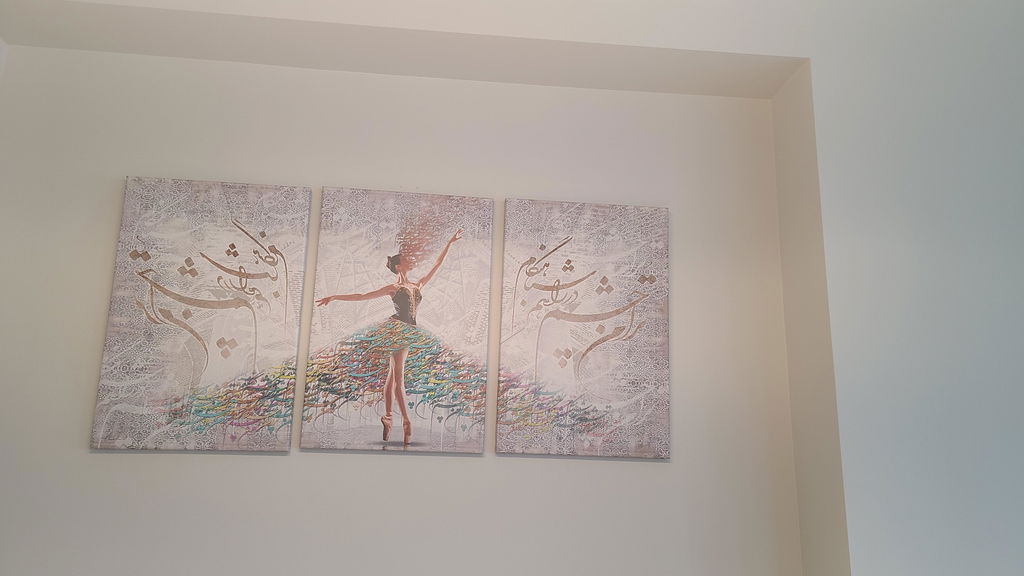
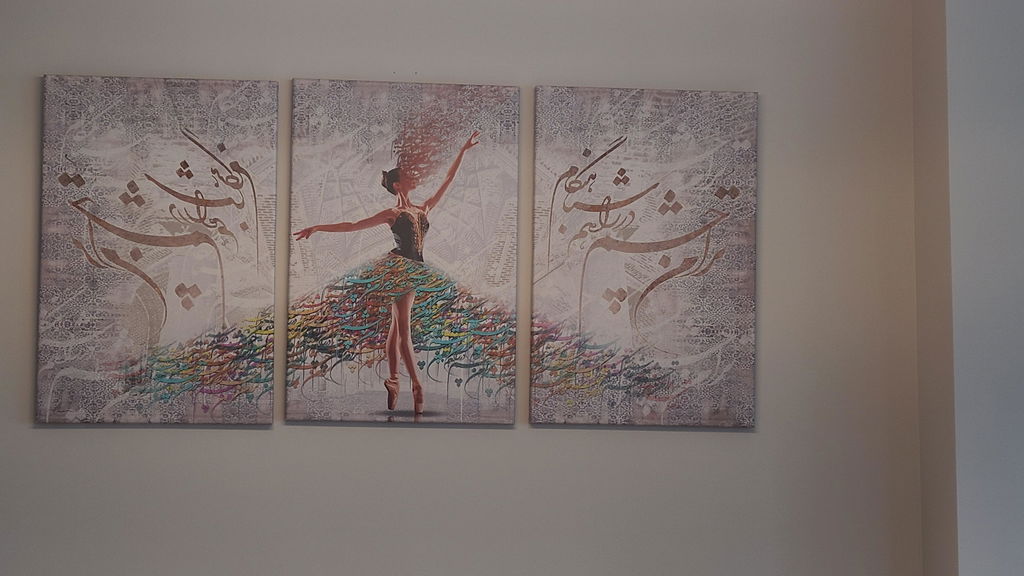
Persian wall art is contemporary artwork built on Iranian visual traditions — nastaliq calligraphy, the geometry of glazed tilework, miniature painting, and the symbols of ancient Persia. Every piece in this collection pairs a real line of Persian poetry or a heritage motif with modern colour and composition, printed on gallery-wrapped canvas and made to order.
This is the full ORIAVI catalogue. If you already know what you are looking for, the collections below narrow it down quickly.
Poetry as something you live with
In Iranian homes, a line of verse on the wall is ordinary furnishing rather than decoration. Hafez sits by the door; Rumi hangs where people gather. The habit is old enough that most Persian speakers can finish a line they have only half read. These pieces carry that practice into a contemporary interior: the verse stays in the original Persian, set in calligraphy, while the English title on each product page conveys the sense of the line rather than translating it word for word.
The poets here span eight centuries — Ferdowsi in the eleventh, Rumi and Saadi in the thirteenth, Hafez in the fourteenth, and modern voices including Nima Yushij, Forough Farrokhzad and Sohrab Sepehri.
The visual traditions
Nastaliq calligraphy. The cursive Persian script developed in the fourteenth century, with a sloping baseline that lets a single line be arranged as a shape rather than a straight row of text. It remains the standard hand for Persian poetry, and it is the backbone of most of this catalogue.
Kashi-kari tilework. The glazed geometry that covers domes and courtyards across Isfahan, Shiraz and Mashhad, rebuilt on canvas in the turquoise, cobalt and gold the tradition is built on.
Achaemenid heritage. The Faravahar, the columns of Persepolis, the winged bulls of the Apadana and the tomb of Cyrus — motifs carved in stone in the sixth to fourth centuries BCE, treated here in relief textures and flattened modern colour.
Choosing a size
The usual guide: artwork should span roughly two-thirds the width of whatever furniture sits beneath it, hung so its centre falls at about eye level — 145 to 150 cm from the floor.
| Size |
Works well |
| 12×8 in · 30×20 cm |
Shelf, desk, or filling out a gallery wall |
| 24×16 in · 60×40 cm |
Above a console table or in a narrow hallway |
| 30×20 in · 75×50 cm |
A small living-room wall or above a nightstand |
| 36×24 in · 90×60 cm |
Above a two-seater sofa or a bed |
| 48×32 in · 120×80 cm |
Above a three-seater sofa, or as a single feature piece |
Portrait formats suit narrow walls and the space between two windows. Landscape and panoramic pieces want width — above a sideboard, a sofa, or along a hallway. Diptychs and triptychs are listed with their panel count on each product page.
How each piece is made
Every canvas is printed to order and stretched over a wooden frame, gallery-wrapped so the image continues around the edges and no frame is needed. Production happens close to the delivery address — in the US, Canada, Europe, the UK or Australia — which keeps transit short. Pieces arrive ready to hang.
If you have a verse, a name or a photograph in mind that is not in the catalogue, see custom wall art.
Questions
Is the Persian text on these pieces real?
Yes. Every piece that carries text uses an actual line of Persian poetry in the original script, not decorative approximation. A Persian speaker can read it.
What is nastaliq?
A cursive Persian script developed in the fourteenth century, recognisable by its sloping baseline and the way words stack diagonally. It is the script most associated with Persian poetry.
Do I need to frame these?
No. The canvas is gallery-wrapped over a wooden frame, with the image continuing around the sides, and hanging hardware is fitted.
Which size should I order?
Measure the wall first and aim to fill about two-thirds of the available width. Exact dimensions for every size are listed on each product page.
Do these make good gifts?
They are bought most often for Nowruz, weddings and housewarmings, particularly within the Iranian diaspora, where a familiar verse carries meaning that generic decor does not.