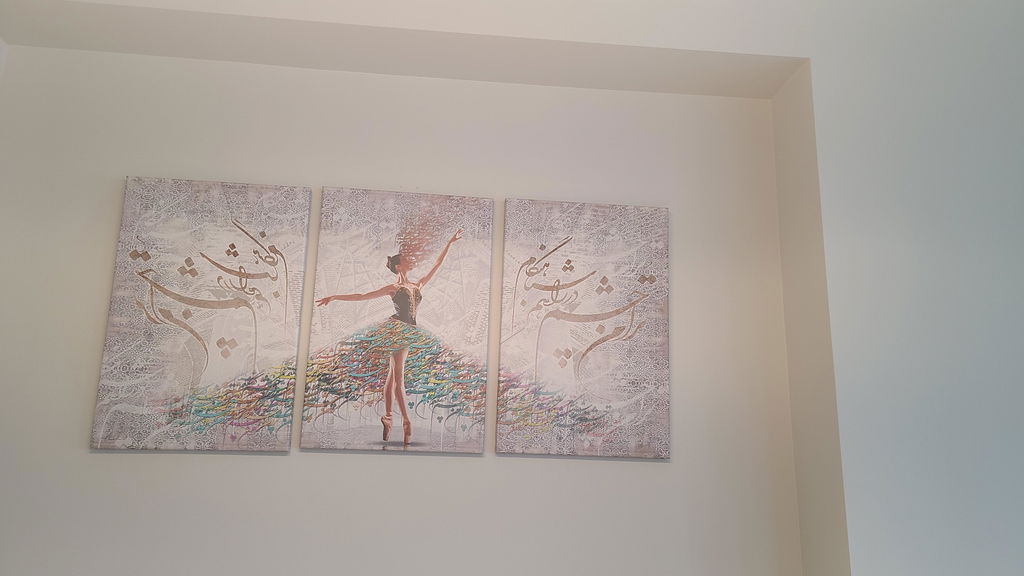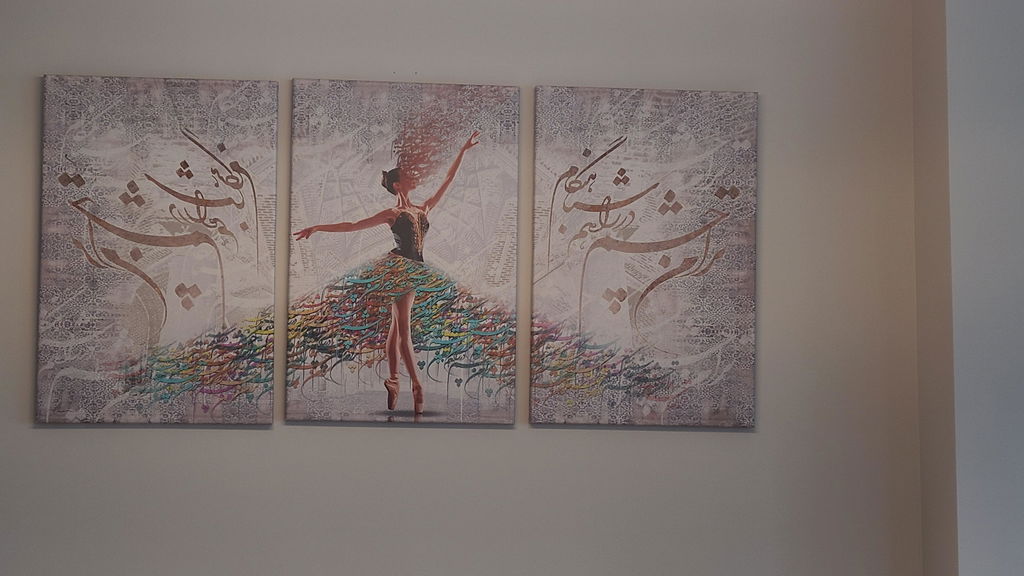


As a starting point, wall art should span roughly two-thirds the width of the furniture beneath it, hung so its centre sits about 145 to 150 cm from the floor — close to eye level for most people. Those two rules solve most rooms. The rest is adjusting for ceiling height, furniture scale and how far back you usually stand.
The two rules that matter most
Two-thirds the width below. A three-seater sofa is usually 200 to 220 cm wide, so a single piece of about 120 to 150 cm reads as balanced. Go much narrower and the artwork looks stranded; go the full width and the wall feels crowded.
Centre at eye level. Galleries hang at roughly 145 to 150 cm to the centre of the work. Above furniture, leave 15 to 20 cm between the top of the sofa or headboard and the bottom of the frame — enough that the two read as one group rather than two separate things.
If the two rules disagree — a very low sideboard, for instance — follow the furniture. The eye reads the relationship between the piece and what sits under it before it notices absolute height.
Size by room
Sizes vary a little by artwork, and every product page lists exact dimensions. These bands cover the usual cases.
| Size band | Roughly | Where it works |
|---|---|---|
| Small | 8×12 in · 20×30 cm | Best in multiples — a gallery wall, a shelf grouping, a narrow strip. Rarely satisfying on its own |
| Medium | 16×24 in · 40×60 cm | Above a console table, in a hallway, or beside a doorway |
| Large | 24×36 in · 60×90 cm | Above a two-seater sofa, a bed, or as the single piece in a small living room |
| Extra large | 32×48 in · 80×120 cm | Above a three-seater sofa, over a fireplace, or as a feature piece on an empty wall |
What we see after delivery
Two patterns come up again and again in what customers tell us once the canvas is on the wall.
The smallest sizes disappoint more often than any other. The 8×12 inch and 8×8 inch pieces are the ones people most often ask to exchange. On a screen they look substantial; on a wall they read as an accent rather than as artwork. Nearly every exchange we handle runs in the same direction — smaller to larger, almost never the reverse.
There is one exception, and it is a good one. Customers who buy several small pieces deliberately, to build a gallery wall, are consistently pleased with them. Small works when it is plural. It seldom works alone.
The bestseller is the largest standard size. Across the catalogue, 32×48 inches (80×120 cm) outsells every other option — and a steady stream of customers ask us to produce something larger still as a custom order.
Both patterns point the same way. When you are hesitating between two sizes, the larger one is the one you will be glad you chose.
How high to hang it
Measure to the centre of the artwork, not the top. Aim for 145 to 150 cm from the floor in a room with standard ceilings.
Two exceptions. In a dining room where people are usually seated, drop the centre by 10 to 15 cm. And with ceilings above about 3 metres, raise everything slightly — artwork hung at strict eye level in a tall room can look like it has slipped down the wall.
Sets of two and three
A diptych or triptych is measured as one piece. Add the panel widths together, add the gaps between them, and apply the two-thirds rule to that total.
Keep the gaps small and even — 5 to 8 cm between panels usually reads best. Wider gaps make the panels look like separate artworks that happen to be near each other. Align the panels along their centres rather than their tops, especially if the panels are not identical in height.
The same logic applies to a gallery wall of small pieces. Treat the whole arrangement as one shape, decide its outer dimensions first, and keep the spacing between pieces consistent throughout.
Portrait, landscape, or panoramic
Orientation matters as much as size, and it is decided by the wall rather than by taste.
- Portrait suits narrow walls, the space between two windows, a stairwell, or a corner beside a doorway. It also draws the eye upward, which helps in rooms with low ceilings.
- Landscape is the safest choice above a sofa, a bed or a sideboard, because it echoes the shape of the furniture underneath.
- Panoramic works where you have real width — a long hallway, above a wide console, or spanning a headboard.
- Square is the most flexible in an awkward space, and squares hang well in pairs or grids.
Test it before you order
Cut a sheet of paper or newspaper to the exact dimensions you are considering and tape it to the wall. Leave it there for a day and walk past it a few times.
This takes ten minutes and settles the question better than any calculation. Wall size is difficult to judge from a screen, and given how consistently people underestimate it, ten minutes of tape is worth the trouble.
Common mistakes
Hanging too high. The most frequent error by a wide margin. Artwork placed near the ceiling separates from the room and leaves an awkward gap above the furniture.
Going too small. Covered above, and worth repeating: it is the single most common regret.
Matching the wall exactly. Leaving breathing room on either side is what makes the piece look deliberate. Filling the wall edge to edge does the opposite.
Forgetting the viewing distance. A detailed calligraphy piece rewards close looking; if it will only ever be seen from across a large room, choose a size and a composition that hold up at that distance.
Questions
What size wall art goes above a sofa?
For a standard three-seater, a single piece around 120 to 150 cm wide, or a set totalling that width. Leave 15 to 20 cm between the sofa back and the bottom of the artwork.
How high should I hang it?
Centre at 145 to 150 cm from the floor. Lower in a dining room, slightly higher under tall ceilings.
Is it better to go bigger or smaller?
Bigger. Our exchange requests run almost entirely in one direction — people wanting to move up a size, not down.
What is your most popular size?
32×48 inches (80×120 cm), the largest standard option. Customers regularly ask us to go larger still as a custom order.
Are the small sizes worth buying?
Yes, if you are buying several and arranging them together. A single small canvas on a large wall usually disappoints.
Do the canvases need framing?
No. ORIAVI canvases are gallery-wrapped over a wooden frame, with the image continuing around the sides and hanging hardware fitted.
Where do I find the exact dimensions?
Every product page lists them for each available size, in both inches and centimetres. You can browse the full catalogue in Persian wall art.