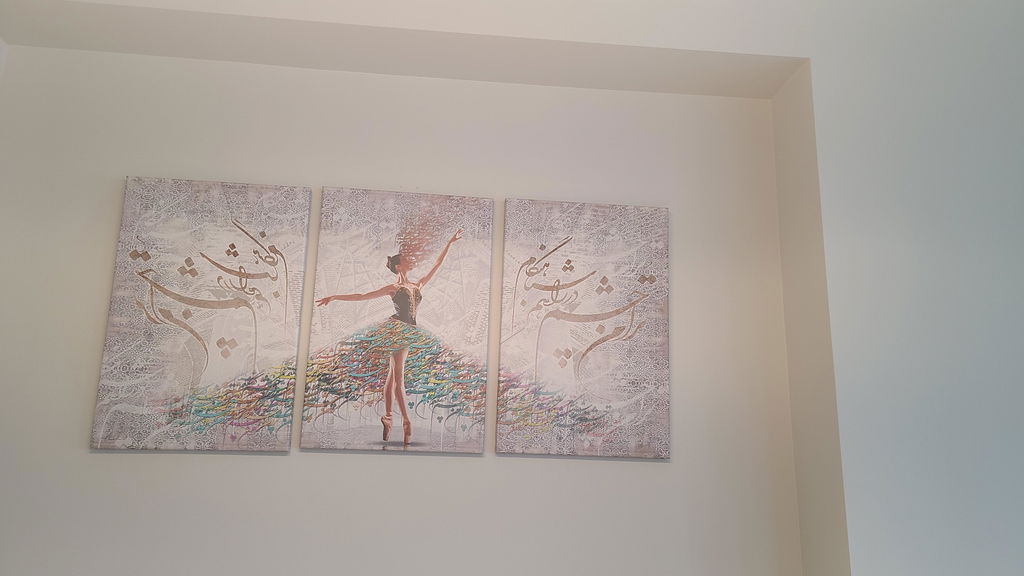
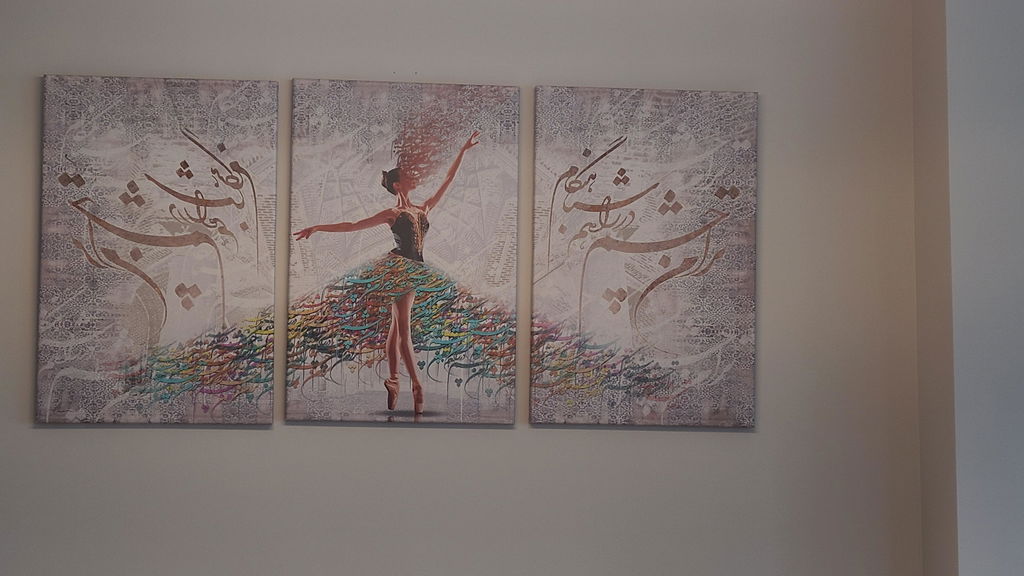
Rumi wall art turns the words of the thirteenth-century Persian poet Jalal ad-Din Muhammad Rumi into contemporary canvas pieces. Each artwork here pairs a verse — set in Persian nastaliq calligraphy — with modern colour and composition, so the poetry works as a design element as much as a text.
The poetry behind the collection
Rumi wrote in Persian, and his two major works are the Masnavi and the Divan-e Shams. The verses chosen for these pieces return to his recurring subjects: love as a transforming force, the whirling sama dance, longing for the beloved, and hich — nothing — understood as freedom rather than emptiness. The original line is always preserved in Persian; the English title conveys its central idea rather than offering a literal translation. We look at the best-known verses, and at why the popular English translations are contested, in Rumi's most famous poems.
Styles in this collection
Some pieces are pure calligraphy, where the movement of the script carries the whole composition. Others place the verse alongside a whirling dancer, a portrait, or Persian tile and mosaic patterns. Palettes run from turquoise and gold through to monochrome, so a favourite verse can usually be found in a version that suits a particular room.
Choosing a size
Above a sofa or bed, artwork that spans roughly two-thirds the width of the furniture below it tends to look balanced — a 48×32 inch canvas over a standard three-seater, for example. For a narrow entryway or the space between two windows, the portrait formats sit better. The size guide covers the rest. Every piece is printed to order, gallery-wrapped over a wooden frame, and arrives ready to hang.
Questions
Who was Rumi?
Rumi (1207–1273) was a Persian poet and Sufi mystic, born in Balkh and settled for most of his life in Konya. He is among the most widely read poets in the English-speaking world today.
Is the Persian text a real verse?
Yes. Every piece carries an actual line from Rumi's poetry in the original Persian script.
Which size should I order?
Measure the wall space first and aim to fill about two-thirds of the available width. Each product page lists the exact dimensions for every size.